

If you are choosing between Strong and Hevy, the real difference is not whether either app can log sets, reps, and weights. Both can. The bigger question is what kind of training experience you want. Strong leans more toward a classic, streamlined lifting log with a long-established reputation for simplicity. Hevy does that too, but adds a much stronger social layer, broader official documentation around free vs Pro limits, and more visible cross-platform ecosystem features.
For most people, the quick answer is this: Strong is a great fit if you want a focused, minimalist workout tracker that stays out of your way, while Hevy is the better fit if you want a modern lifting tracker with community features, generous free functionality, and easier visibility into what you get before paying.
Strong vs Hevy: Comparison Table
| Category | Strong | Hevy |
| Core focus | Simple workout logging and strength tracking | Workout tracking plus social/community motivation |
| Platforms | iPhone, Android, Apple Watch | iPhone, iPad, Android, Apple Watch, Wear OS, iMessage |
| Free version | Yes | Yes |
| Paid plans shown in US App Store / official pricing | $4.99 monthly, $29.99 yearly, lifetime shown; some alternate regional/store prices also appear | $2.99 monthly, $23.99 yearly, $74.99 lifetime |
| Workout logging | Yes | Yes |
| Custom exercises | Yes | Yes |
| Supersets | Yes | Yes |
| Progress charts / stats | Yes | Yes |
| CSV export | Yes | Yes |
| Apple Health | Yes | Yes |
| Social features | Workout sharing | Stronger community features, following, sharing, profiles |
| Best for | Lifters who want a cleaner, more classic logbook feel | Lifters who want tracking plus community and broader integrations |
What is Strong App?
Strong is a workout tracker built around simplicity. On its official site, it positions itself as a clean and intuitive training log and highlights features such as supersets, custom exercises, CSV export, Apple Health, warm-up calculator, Siri Shortcuts, advanced charts, body measurements, workout sharing, timers, and workout scheduling. The messaging is very much about helping you think less and lift more.
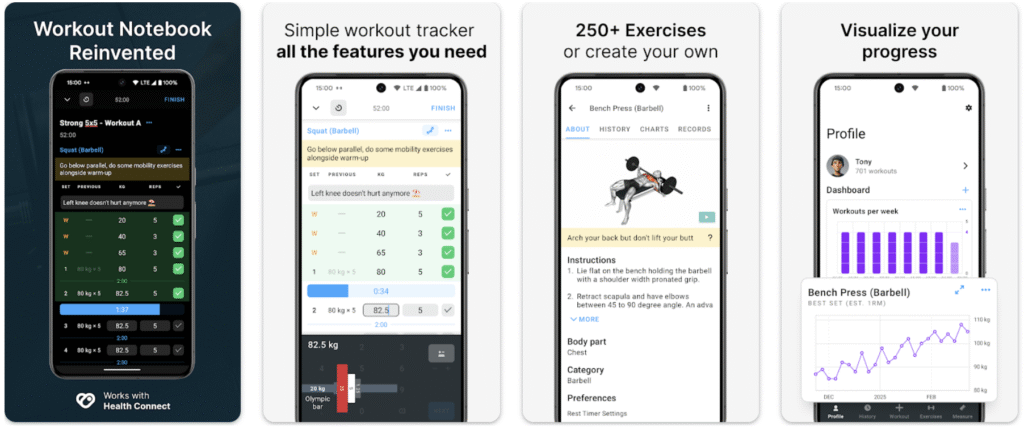
That positioning matches how users talk about it. In Strong’s App Store and testimonial pages, recurring praise centers on ease of use, fast logging, simple design, previous workout reference, and the feeling that it is better than using a paper notebook.
Key features of Strong include:
- Fast workout logging, which makes it easy to record sets, reps, and weight during training without slowing down your session.
- Custom workout routines, allowing users to build personalized training plans based on their own goals and split.
- Warm-up calculator, which supports better workout preparation by suggesting warm-up progression before working sets.
- Progress charts and workout statistics, which help users see long-term trends and monitor improvement over time.
- Previous workout history, so users can compare current performance with earlier sessions and follow progressive overload more easily.
- Siri Shortcuts, adding convenience for users who want faster actions and automation within the Apple ecosystem.
- Workout sharing, allowing users to share routines or completed sessions with others.
What is Hevy App?
Hevy is also a workout tracker for strength training, but its positioning is broader. Its homepage describes it as a free workout tracker for iOS and Android that lets users build routines, track progress, and stay motivated with friends. Its features page also highlights things like folders, routine library, custom exercises, widgets, and HevyGPT, while its help center makes a bigger deal than Strong does about social features, syncing, imports, and integration flows.
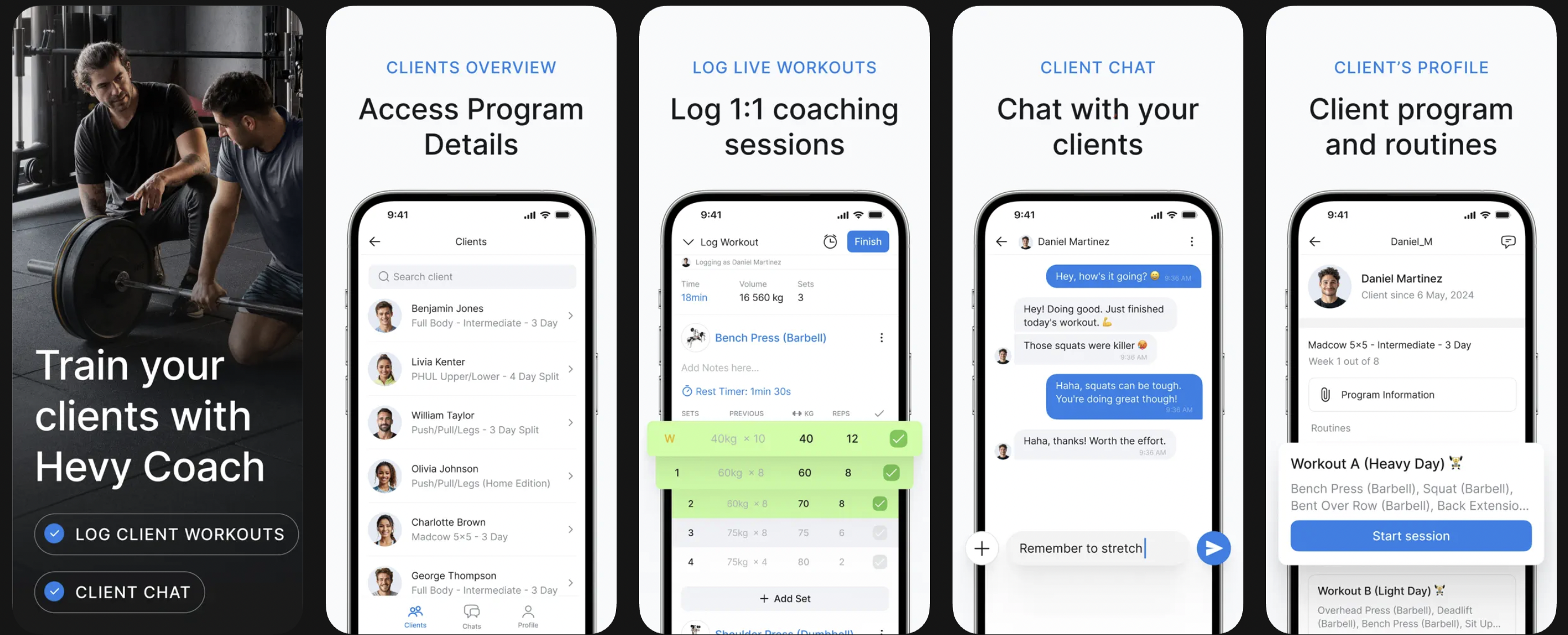
Hevy also publicly emphasizes scale and social proof more aggressively. Its homepage says it is loved by 12+ million athletes and shows 4.9 ratings across App Store and Google Play with 430,000+ ratings combined. Even if you take brand-owned claims with some caution, the independent store pages do support very strong ratings and heavy user adoption.
Key features of Hevy include:
- Workout logging, which allows users to track sets, reps, weight, and completed exercises during each training session.
- Progress tracking, helping users monitor how their lifts and overall performance improve over time.
- Charts and workout statistics, which make long-term progress easier to visualize and understand.
- Widgets, adding quicker access and extra convenience from the device home screen.
- Apple Watch support, allowing users to log or follow workouts more easily during training.
- Social features, such as following friends and sharing workouts, which make the app feel more community-driven.
- HevyGPT, which adds an AI-powered layer to parts of the workout experience.
Hevy vs Strong: Features comparison
Both Hevy and Strong cover the core workout-tracking features most users need, but they differ in how broad the overall experience feels. This section compares their main features side by side, from logging and planning to social tools and integrations.
Workout logging
Both apps cover the basics very well. Strong publicly lists supersets, custom exercises, timers, RPE, advanced charts, and workout scheduling. Hevy’s official materials and help center show logging, routines, previous workout values, exercise notes, timers, plate calculator, and workout planning tools.
In practice, the difference is less about whether either app can log a session and more about feel. Strong’s public messaging and user feedback consistently stress that it is fast, clean, and uncluttered. Hevy’s feedback also praises ease of use, but often mentions community, flexibility, and richer tracking context alongside the actual logging flow.
Workout planning
Strong includes workout scheduling and custom routines in its feature list, which makes it more than just a basic logbook. Hevy goes further in the way it explains planning: its help center describes a routine library, folders, reusable routines, pre-built programs, and the ability to save completed workouts as routines.
That makes Hevy feel a bit more explicit and structured for users who like planning blocks of training ahead of time. Strong still supports planning, but its public materials put more emphasis on tracking than on programming ecosystem depth. That is an interpretation based on how each company presents the product, not a claim that Strong cannot support serious programming.
Progress tracking
Progress tracking is a strength for both apps. Strong highlights advanced charts, personal bests, estimated 1RM, total weight lifted, body measurements, and export options. Hevy highlights graphs, previous performance values, exercise stats, projected 1RM, session volume, total reps, heat maps, muscle distribution, and monthly reports in Pro.
Hevy is more transparent about where free ends and Pro begins. Its help article says the free version includes 3 months of data history, while Pro unlocks all-time data, unlimited routines, unlimited custom exercises, advanced tracking features, and a warm-up calculator. Strong clearly has a free tier and Pro subscription, but in the sources I reviewed, it is less explicit in public-facing docs about the exact free-plan boundaries.
Exercise library
Strong’s Google Play listing says it includes a wide choice of cardio and strength exercises, exercise instructions, and a growing library of animated videos, while also allowing users to add their own exercises and routines. Hevy’s help center says it has 400+ exercises, plus filters, demo animations, step-by-step instructions, and custom exercises.
So both are strong here, but Hevy’s documentation is more specific. If you value clearer official detail about how the exercise library works, Hevy currently gives you more to evaluate before you download.
Community and social features
This is the clearest product difference. Strong includes workout sharing in its feature list, but its brand feels primarily like a personal training log. Hevy, by contrast, repeatedly presents itself as a social training platform. Its homepage mentions tracking progress with friends, and its official social features documentation covers following users, sharing routines, and broader community interaction.
If you want accountability, workout sharing, public profiles, or a sense of community inside the app, Hevy is the more obvious choice. If you want your tracker to feel more private and utility-first, Strong likely fits better.
AI Features
When it comes to AI, Hevy is clearly ahead of Strong. Strong’s public product pages focus on traditional workout-tracking features like logging, charts, timers, custom exercises, and integrations, but they do not currently highlight a dedicated AI feature.
Hevy, on the other hand, offers HevyGPT, a feature that lets users generate workout plans in ChatGPT and save them directly to their Hevy profile. This makes AI part of the workout setup process, especially for users who want faster program creation.
Strong vs Heavy: Pricing comparison
On the current US App Store listing, Strong shows $4.99 per month, $29.99 per year, and a lifetime option at $99.99, with some alternate price entries also appearing on the page. Strong’s terms also confirm monthly, yearly, and lifetime Pro options.
Hevy’s pricing is simpler in the sources reviewed. Its official pricing page and US App Store listing show $2.99 monthly, $23.99 yearly, and $74.99 lifetime. Its help center also notes occasional first-year annual promotions for first-time Pro subscribers, though that is not always active.
So on current visible pricing, Hevy is cheaper across monthly, yearly, and lifetime tiers. That alone does not make it better, but it does make Hevy easier to recommend on pure value for money. Strong can still make sense if you specifically prefer its interface and classic tracking-first feel.
Free and paid versions comparison
Strong has a free account and a Pro subscription tier. Its terms confirm monthly, yearly, and lifetime Pro options, and the App Store listing shows active US in-app purchase prices including monthly, yearly, and lifetime options. However, the exact boundary between free and Pro is not laid out as clearly in Strong’s public docs as it is in Hevy’s help center.
Hevy is more transparent. Its help center explicitly says the free version includes a limit of 4 routines, 3 months of data history, and 7 custom exercises, while Pro unlocks unlimited routines, all-time data history, unlimited custom exercises, more advanced tracking, and warm-up calculator access. That clarity is useful because users can compare value before upgrading.
For value, Hevy has the edge in transparency and entry-level generosity. Strong may still work very well for free users, but based on current official materials, Hevy makes it easier to understand exactly what you get without digging.
Interface and user experience comparison
Strong’s biggest advantage is its reputation for staying simple. Its own site leans into “Nothing you don’t” and “Think less. Lift more,” and user feedback repeatedly praises the clean design, quick logging, intuitive flow, and low friction mid-workout.
Hevy also scores very highly on usability, but the user narrative is slightly different. Reviews often mention that it is easy to use while also highlighting the interface, timer, flexibility, and community. That suggests Hevy has managed to add more layers without feeling overly heavy for most users.
My read is this: Strong feels more minimalist, while Hevy feels more modern and feature-expanded. Neither looks difficult to use, but Strong is the more obvious pick for people who hate clutter, while Hevy is the better pick for people who want more from one app without leaving the workout-tracker category. This is an interpretation based on feature presentation and review language.
Strong vs Hevy: Other app integrations
Strong officially lists Apple Health, CSV export, Siri Shortcuts, and third-party integrations on its website. It also supports Apple Watch. Based on the reviewed public materials, that gives Strong solid utility for Apple-centric users, though its current public docs are less explicit than Hevy’s about the broader integration map.
Hevy is more openly documented here too. Its help center confirms Apple Health syncing, Google Fit syncing through Health Connect, MyFitnessPal connection through Apple Health or Health Connect, Apple Watch syncing, Wear OS support, data export, Strong CSV import, and a public API linked from its features page.
This makes Hevy the better choice for users who care about moving data between apps, connecting into a broader health ecosystem, or switching from Strong without losing history. That last point is especially important because Hevy explicitly documents Strong CSV import.
User reviews comparison
Strong’s ratings are excellent on Apple’s App Store, where it currently shows 4.9 out of 5 from 108K ratings in the US listing. On Google Play, it shows 4.3 stars with about 42K reviews, which suggests Strong is perceived more favorably on iOS, or at least that sentiment varies more by platform.
That stronger iOS sentiment also shows up in the wording of reviews. On the App Store, one user calls Strong “the best tracking app for strength training and weightlifting”, while another says it is “beautifully designed, very flexible and great for weight lifters at any level.” On Google Play, a positive review highlights practical features like free workout setups, warm-ups, rest timers, and previous-workout tracking.
Still, not all feedback is purely positive. Some Strong reviews point to limitations around exercise flexibility and customization, which suggests that while the app is widely praised for simplicity, some users want more control in edge cases.
Hevy also shows very strong ratings: 4.9 out of 5 from 62K ratings on the US App Store, and 4.9 stars with roughly 204K–206K reviews on Google Play. That is a strong sign of more consistent cross-platform sentiment.
The review language around Hevy is also very consistent. One App Store review describes it as “super easy to use” with a “great community,” while another says it “gets the job done even with just the free option.” On Google Play, one user writes that “the free version is essentially the same as the Pro version” aside from routine limits, which aligns closely with Hevy’s public explanation of its subscription model.
Overall, Strong users most often praise simplicity, utility, and fast workout logging, while Hevy users more often highlight interface quality, flexibility, analytics, and the social/community side of the app. Based on the current public ratings and visible review themes, Hevy looks a bit more consistent across platforms, while Strong remains especially strong on iOS.
Sources: Strong on the App Store, Strong on Google Play, Hevy on the App Store, Hevy on Google Play
Best for different types of users
Strong is best for lifters who want a clean, classic, low-distraction training log and especially for people who are deep in the Apple ecosystem. Hevy is best for users who want a more connected experience with social motivation, stronger public documentation, easier migration and integration options, and cheaper visible pricing.
Beginners could use either app, but Hevy may be the easier recommendation because its free plan is more clearly explained and its review base suggests strong ease of use across platforms. Advanced lifters could also use either one, but Strong may appeal more to those who want a more stripped-down tool, while Hevy may appeal more to those who like detailed tracking plus ecosystem features.
Final verdict
Strong is the better app for people who want the most classic lifting-log experience: simple, proven, fast, and focused. Hevy is the better overall choice for most new users because it is cheaper in current published pricing, clearer about what free vs Pro includes, stronger on social features, better documented on integrations, and more consistent in public ratings across iOS and Android.
So the practical recommendation is this: choose Strong if you want a minimalist workout tracker that feels like the digital version of a really good gym notebook. Choose Hevy if you want a workout tracker that also feels like a connected fitness platform.
FAQ
Is Strong better than Hevy?
It depends on what you value. Strong is better for minimalist tracking, while Hevy is stronger on community, integrations, and pricing transparency.
Is Hevy cheaper than Strong?
Based on the currently visible US pricing sources reviewed, yes. Hevy shows $2.99 monthly, $23.99 yearly, and $74.99 lifetime, while Strong’s US App Store listing shows higher visible monthly, yearly, and lifetime prices.
Which app has better social features?
Hevy. Its official product and help pages make social interaction a core part of the product.
Which app is better for Apple Watch users?
Both support Apple Watch, but Hevy also more clearly documents watch syncing and wider ecosystem connections in the sources reviewed.
Can you move from Strong to Hevy?
Yes. Hevy officially documents importing Strong CSV files.
Leave a Reply