
At first glance, Runna and Strava can look like they belong in the same category: both are popular with runners, both work on your phone, and both help you stay consistent. If you’re trying to get fitter, run more often, or improve your race performance, it’s easy to see why people compare them.
But they’re built around very different ideas. Runna is primarily a structured coaching and training app, focused on helping you follow a plan and improve over time. Strava is more of a tracking, social, and activity log platform, designed to record workouts, analyze performance, and connect you with a large fitness community.
So the real question isn’t which app has more features overall. It’s which one fits your running style, your goals, and how much structure you want from your app.
Runna vs Strava — Full Comparison Table
| Category | Runna | Strava |
|---|---|---|
| Core purpose | Guided running coaching and training plans | Workout tracking, analytics, and social fitness platform |
| Best for | Runners who want a plan and progression | Runners who want tracking, community, and performance history |
| Primary audience | Beginners to advanced runners training for goals | Casual runners, serious runners, cyclists, and active communities |
| Ease of use | Easy once a plan is set up | Very easy for basic tracking; more complex as you dig deeper |
| Design style | Clean, coach-like, task-focused | Social feed + data dashboard style |
| Main strengths | Adaptive plans, structured training, race prep | Large community, excellent activity tracking, social features |
| Main limitations | Less social; narrower focus than Strava | Training guidance is less personalized without premium tools |
| Free version | Limited/free trial-style access varies by offering | Strong free tier for tracking and social use |
| Paid plan / pricing model | Subscription-based | Freemium subscription model for premium analytics/features |
| Platforms | iOS, Android | iOS, Android, web |
| AI features | Limited, training-plan adaptation/coach-like recommendations | Limited AI; mainly analytics and auto-generated insights in some features |
| Customization | High for training goals, distances, and race plans | Moderate; routes, privacy, activity settings, profile options |
| Integrations | Apple Health, Garmin, Strava and other fitness ecosystem tools | Wide support for watches, sensors, fitness apps, and equipment ecosystems |
| Offline access | Limited practical offline use during workouts once plans are synced | Strong offline recording support on device, syncs later |
| Ratings | Generally very positive, especially among runners focused on training | Very high ratings and broad popularity across endurance users |
| Common criticism | Subscription cost; less useful if you only want tracking | Paywall for best analytics; social noise; privacy concerns |
The biggest difference is that Runna is built to tell you what to do next, while Strava is built to track what you already did. Runna is the better coaching app; Strava is the better activity ecosystem.
What Is Runna?
Runna is a running app built around structured training plans. Instead of just logging your runs, it gives you a guided path toward a goal such as running your first 5K, improving your half-marathon time, or training consistently with fewer injuries. That makes it feel more like a digital coach than a simple tracker.
The main problem Runna solves is uncertainty. Many runners don’t know how hard to run, how often to train, or how to balance easy runs, interval sessions, and recovery. Runna organizes those decisions into a plan, which is especially useful if you prefer a clear day-by-day schedule.
What makes Runna different is its coaching-first approach. The app is centered on progression, not just logging. It tries to make training feel manageable by breaking goals into small, structured sessions. That can be very motivating for runners who like guidance and accountability.
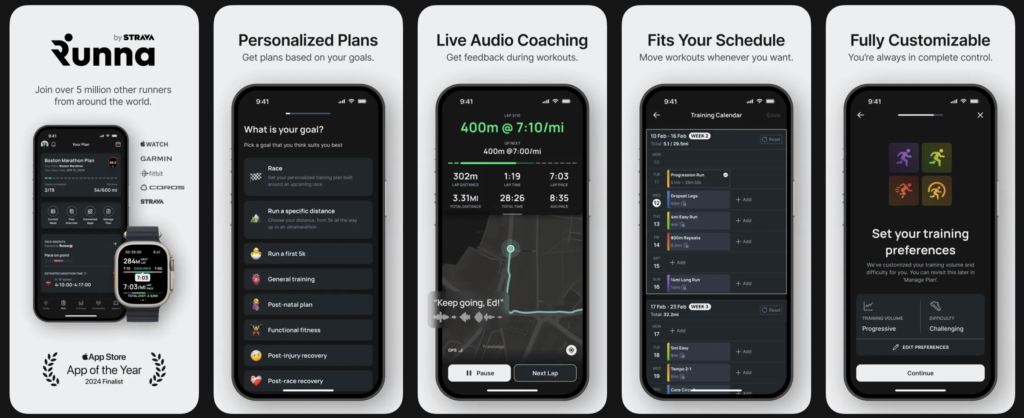
Runna is best for runners who want a plan that feels personalized without hiring a human coach. It works well for beginners, recreational runners, and people training for a specific race. It may be less appealing if you mainly want a social network, advanced activity history, or a broad all-purpose fitness platform.
Where it may fall short is breadth. Compared with Strava, Runna is more specialized. If you want the biggest community, live segments, route-sharing culture, and a universal workout log, Runna is not trying to replace that.
Key strengths of Runna:
- Structured running plans for different goals and distances
- Good for beginners who want clear direction
- Makes training feel more manageable and less guesswork-based
- Helpful progression and workout variety
- More focused than general fitness apps
- Strong fit for race preparation
What Is Strava?
Strava is a fitness tracking and social platform best known for logging runs and rides, analyzing performance, and connecting users through a large community. It started as a runner and cyclist tracking app, but it has grown into one of the most recognized names in endurance fitness.
Its main problem-solving strength is visibility. Strava gives you a place to record every workout, review pace, distance, elevation, and splits, and compare your efforts over time. For many users, it becomes their central fitness diary.
What makes Strava different is its community layer. It is not just about data; it’s also about motivation through social interaction, route discovery, segments, club challenges, and sharing workouts with friends. That makes it feel more like a fitness network than a coaching app.
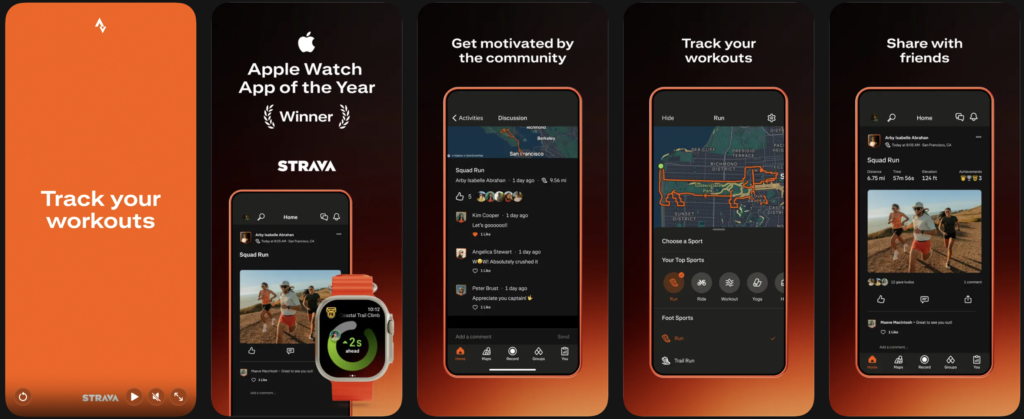
Strava is best for runners who want an easy way to track workouts and stay engaged with a broader fitness community. It is also great for athletes who use multiple devices or sports, since it supports a wide range of integrations and activity types.
Where it may fall short is individualized training. Strava can show you what you did, but it is not as strong at telling you exactly what to do next. Some of its more advanced performance insights are also behind a subscription.
Key strengths of Strava:
- Excellent workout tracking and activity history
- Large, active community of runners and cyclists
- Strong integration with watches, apps, and fitness devices
- Useful performance analysis and route tools
- Good free version for basic users
- Works well across multiple sports
Runna vs Strava: Ratings and User Popularity
Both apps are rated well on the main app stores, but Strava is clearly the bigger mainstream platform. On the Apple App Store, Runna has a 4.9/5 rating from 27K ratings, while Strava has a 4.8/5 rating from 354K ratings. On Google Play, Runna has 4.5/5 from 22.8K reviews and 1M+ downloads, while Strava has 4.2/5 from 1.09M reviews and 100M+ downloads.
That gap in review volume and downloads shows why Strava feels more mainstream. It has much broader adoption across runners, cyclists, walkers, and general fitness users. Strava also says it has more than 180 million users, which reinforces its scale and community-led position.
Runna, though, performs especially well with people who want structured coaching. Its store ratings are extremely strong for a more specialized running app, especially on iOS. That supports the idea that Runna is more niche and goal-oriented: smaller in scale, but very focused in value for runners following a training plan.
If you also look beyond app stores, the picture gets a bit messier. On Trustpilot, Runna has a 4.0/5 TrustScore from 1,076 reviews, while Strava has a 1.5/5 TrustScore from 440 reviews. That suggests app store ratings are better for judging product satisfaction inside the app, while Trustpilot tends to reflect subscription and support complaints more heavily.
So in practical terms, Strava wins on scale, community, and mainstream popularity, while Runna stands out for focused coaching and stronger satisfaction among runners who want a plan. A casual user may prefer Strava’s breadth and social features, while someone training for a 5K, half marathon, or marathon may find Runna a better fit.
Runna vs Strava: Pricing Comparison
Both apps use subscriptions, but they price different kinds of value. Runna is built around paid coaching and structured training plans, while Strava offers a real free tier for tracking and social features, then charges for deeper analysis and premium tools. Runna’s official pricing page currently lists a 7-day free trial, then $19.99/month or $119.99/year in the US. Strava’s official pricing page lists $11.99/month or $79.99/year for an individual subscription in the US, and its main site also promotes a 30-day free trial for eligible users.
| Pricing Factor | Runna | Strava |
|---|---|---|
| Free version | No full free tier for coaching; centered on a 7-day free trial | Yes; free account with workout logging, tracking, and community features |
| Free trial | 7 days | 30 days for eligible users |
| Monthly plan | $19.99/month | $11.99/month |
| Yearly plan | $119.99/year | $79.99/year |
| Family plan | No public family plan listed on main pricing page | $139.99/year for family plan |
| Student discount | No student plan shown on main pricing page | $39.99/year for verified students |
| Lifetime purchase | No | No |
| Best value for | Runners who want structured coaching and race plans | Users who want tracking, community, and optional premium analysis |
These prices are current US web prices and can vary by country, taxes, discounts, or whether someone subscribes through Apple or Google instead of directly on the web. For example, Strava’s App Store listing shows in-app purchase prices that differ from its web pricing in some regions, which is pretty normal for subscription apps.
For budget-conscious users, Strava is usually the easier starting point because you can join and use core tracking features for free, then upgrade only if you want extra training metrics, route tools, or deeper analysis. Strava’s homepage explicitly positions the app as something you can “join for free.”
Runna can still offer better value for runners with a specific goal, because the subscription is tied directly to personalized training plans and coaching-style structure rather than just tracking. Its pricing page makes that positioning pretty clear: the paid plan is about full plan access, not just premium analytics.
Features Comparison: Runna vs Strava
Ease of use
Runna is straightforward if your goal is to follow a plan. You answer a few questions, choose a goal, and the app tells you what to do. That simplicity is one of its biggest advantages.
Strava is easy at the basic level too, especially for recording and viewing workouts. But once you start exploring segments, clubs, routes, privacy settings, and premium analytics, it becomes a much richer and more layered product.
Runna benefits users who want less decision fatigue. Strava benefits users who want flexibility and don’t mind a busier interface.
Planning / tracking / organization tools
Runna is clearly stronger for planning. Its whole model is built around structured progression, which is ideal for training toward a race or fitness target.
Strava is stronger for tracking and historical organization. It gives you an excellent record of past workouts, performance trends, and activity history, but it does not guide the training process in the same way.
If you need a coach-like plan, Runna wins. If you need a workout archive and performance log, Strava wins.
Customization
Runna lets you customize by goal, race distance, fitness level, and schedule. That is useful because the app shapes the plan around your objective.
Strava offers more customization in profile settings, privacy, routes, feed experience, and device ecosystem, but less in terms of personalized training structure.
Runners who want a tailored training journey will usually prefer Runna. Users who want to control how their fitness data is displayed and shared will prefer Strava.
Automation or AI features
Runna’s intelligence is mostly in how it adapts and structures training. It feels more like a guided coaching system than a generic app with tips.
Strava has some smart insights and automatic organization of activities, but it is not primarily an AI-driven coach. Its value is in analytics and network effects rather than automated training decisions.
If you want the app to help plan your training, Runna is better. If you want automatic workout recording and summaries, Strava is better.
Integrations
Strava is the clear leader here. It works with a wide range of watches, sensors, fitness apps, and platforms, which is one reason it is so widely used.
Runna integrates with key health and training ecosystems too, but it is more selective and training-focused. That makes sense for its product design, but it is not as universal as Strava.
Users with a lot of fitness hardware or multiple apps will usually find Strava easier to connect into their setup.
Cross-platform support
Strava has an advantage because it is available on mobile and web, making it easier to review workouts on a larger screen.
Runna is primarily mobile-first, which suits the training experience but can feel narrower if you want a desktop dashboard.
If you want to analyze data on a computer, Strava is stronger. If you want a simple mobile coaching experience, Runna is enough.
Design and interface
Runna has a cleaner, more focused interface that supports training. It is designed to reduce confusion and keep you on task.
Strava’s interface is more social and data-rich. That is great if you like browsing activity feeds or digging into workout details, but it can feel busier.
People who prefer calm, structured design usually like Runna. People who enjoy a community feed and performance dashboard usually like Strava.
Runna vs Strava for Race Training
For race training, Runna is usually the better choice. It is built to create a plan for a specific distance and pace goal, which is exactly what most race-prep runners need.
Strava can absolutely support race training, especially if you already know what workouts to do or you follow a separate coach. But it is better as the tracking layer than the training layer.
If your main goal is to run a 5K, 10K, half marathon, or marathon with structure, Runna is the more direct fit. If your goal is to document and review the training you’re already doing, Strava is the stronger companion.
Real User Reviews: What People Like and Don’t Like
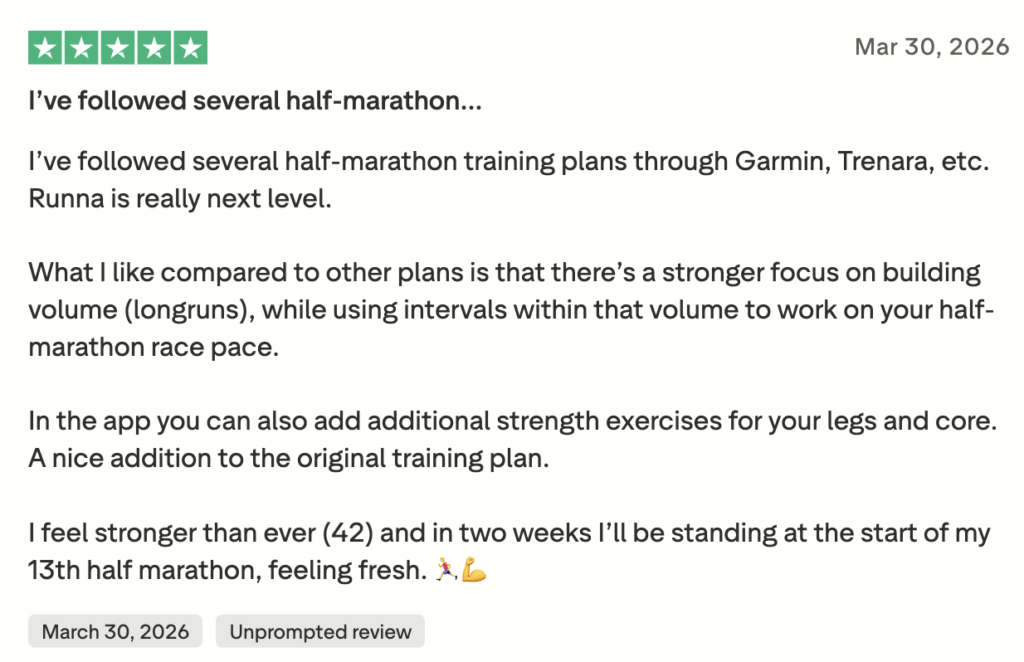
User reviews suggest that Runna is most often praised for structure, clear guidance, and motivation during race prep. In one Trustpilot review, a user said the app was “very easy to use” and helped them cut more than 30 minutes off a marathon PB. In a Reddit discussion, runners also described Runna as helpful because it “gave me structure” and made training feel more manageable for a first half or marathon.
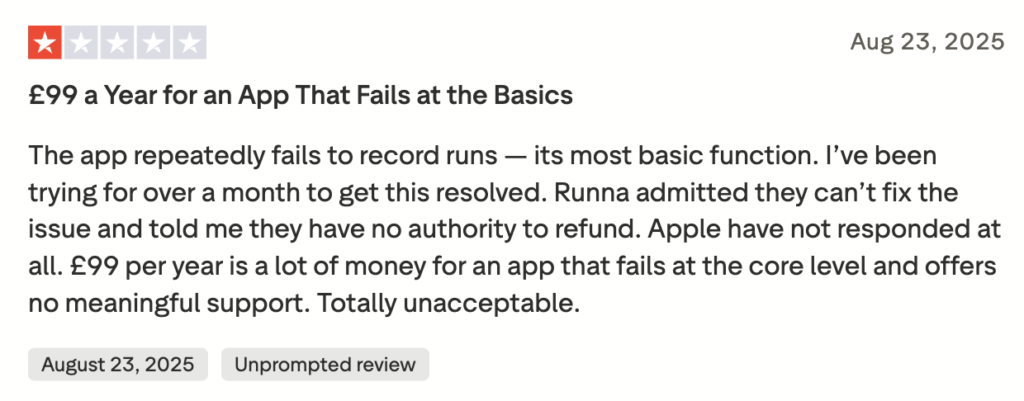
At the same time, some Runna users complain about cost, syncing issues, and limited flexibility. A review on the App Store calls the subscription “quite pricey,” even while recommending it for runners with a specific goal. On Trustpilot, other reviewers mention failed workout uploads, cancellation frustration, or wanting more customization once they become more experienced runners.
So the strongest Runna feedback tends to come from goal-focused runners who want a plan built for them, while the weaker reviews usually come from people who want either a lower price, more control, or a broader all-in-one fitness app. That pattern shows up across both review platforms and running-community discussions.
For Strava, user reviews more often highlight multi-sport tracking, convenience, and the social/community side. On the App Store, one reviewer says it is “one of the best apps” they’ve used because it lets them log swimming, cycling, running and walking in one place. Another App Store review describes Strava as a “great platform” with a “healthy community” and lots of features.
The more negative Strava reviews tend to focus on paywalled features, usability annoyances, and privacy or platform frustration. On Trustpilot, one reviewer complained that Strava’s “Year in Sport” recap was placed behind the premium tier. In Reddit discussions, users also complain about the shrinking free version, price increases, and wanting more tailored privacy controls.
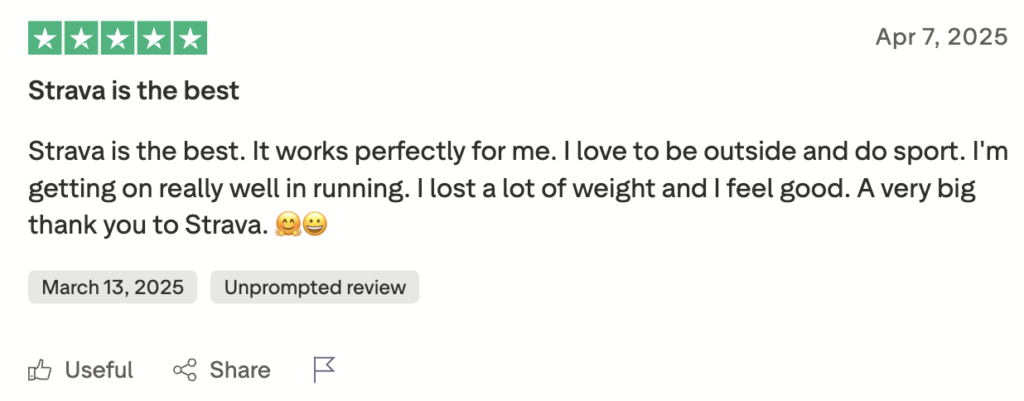
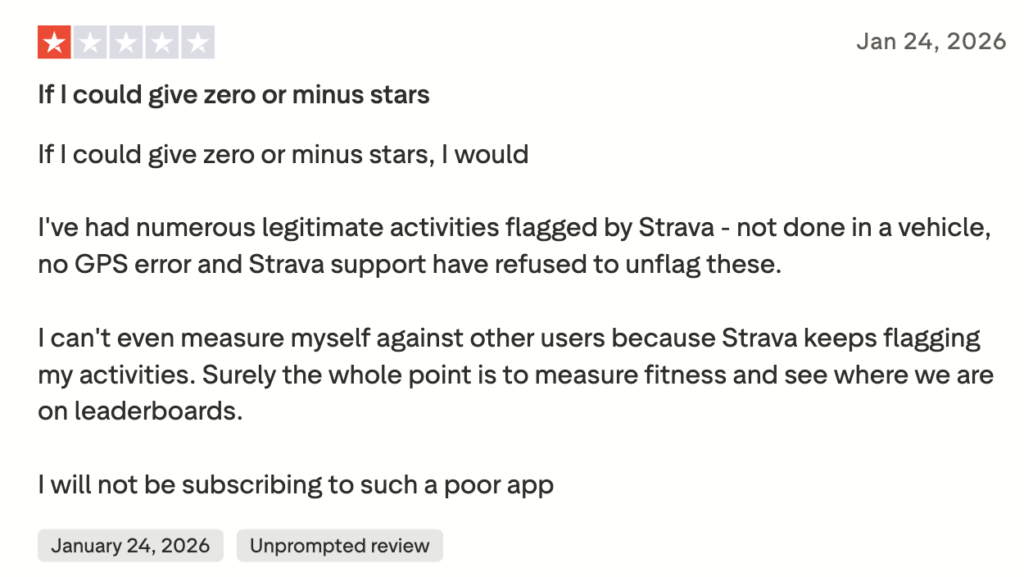
Overall, the review pattern makes the difference pretty clear: Runna is usually loved for coaching structure, while Strava is usually loved for tracking breadth and community. The criticism is different too: Runna gets more pushback on value-for-money and flexibility, while Strava gets more pushback on premium gating and product noise around the core tracking experience.
Which One Should You Choose — Runna or Strava?
Choose Runna if…
- You want a clear running plan
- You are training for a race
- You prefer guided workouts over deciding on your own
- You want a coach-like app experience
- You are a beginner and need structure
- You care more about progress than social features
Choose Strava if…
- You want the best workout tracking and history
- You like sharing runs with friends or clubs
- You use multiple fitness devices or apps
- You want a strong free version
- You care about routes, segments, and activity data
- You want one app for running plus other sports
The simplest way to decide is this: choose Runna if you need help training, and choose Strava if you need help tracking. For many runners, the best setup is actually both—Runna for the plan and Strava for the record. If you want only one app, though, the better choice depends on whether your priority is coaching or community.
FAQs
Is Runna better than Strava for beginners?
Runna is usually better for beginners who want a plan and guidance. Strava is better if the beginner mainly wants tracking and social motivation.
Can Runna replace Strava?
Not usually. Runna is better as a training app, while Strava is better as a tracking and community platform.
Is Strava good for running plans?
Strava is not primarily a running plan app. It is better for logging and analyzing workouts than building structured training schedules.
Does Runna work with Strava?
Yes, many runners use them together so their Runna workouts can be tracked or shared in Strava.
Which app is better for race training?
Runna is better for race training because it is designed around structured progression and specific race goals.
Which app is better value for money?
Strava is usually better value for casual users because of its strong free version. Runna can be better value for users who will actively follow a training plan.
Leave a Reply