
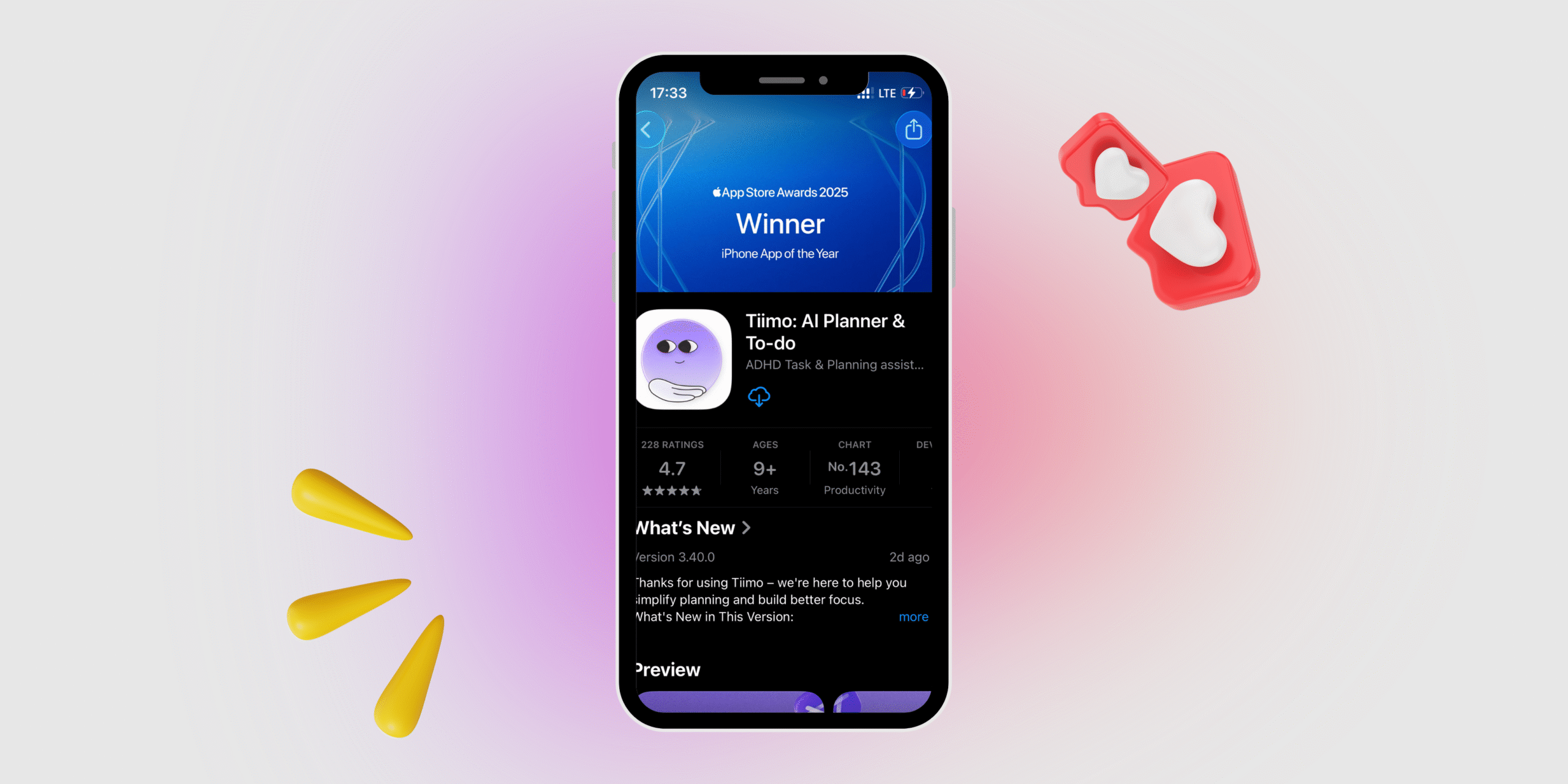
Most productivity apps are built around pressure. They push you to do more, track more, optimize more. For many people, especially those with ADHD or executive-function challenges, this approach backfires. Instead of creating clarity, it creates stress.
Tiimo takes a very different path. It’s a visual planning app designed to help users understand time, build gentle structure, and move through the day with less overwhelm. Rather than focusing on performance, Tiimo focuses on awareness and balance.
| Category | Tiimo |
|---|---|
| What it is | A visual planner focused on time awareness rather than task completion |
| Primary use | Daily planning, routines, and gentle structure |
| Best suited for | People with ADHD, autism, or anyone overwhelmed by classic to-do apps |
| How planning works | Activities are placed on a visual timeline as time blocks |
| User experience | Calm, minimal, and intentionally non-stressful |
| Reminders | Soft nudges instead of aggressive alarms |
| Routines | Designed for repeating daily and weekly rhythms |
| Customization | Icons, colors, and flexible activity types |
| Sharing | Optional shared timelines with others |
| Platforms | iOS, Android, and Web |
| Free plan | Yes, with limited features |
| Paid access | Subscription model |
| Main advantage | Reduces overwhelm and time blindness |
| Main limitation | Not built for complex projects or task hierarchies |
| Overall feeling | Supportive, gentle, and human-centered |
What Tiimo Is Really About
At its core, Tiimo is not a to-do list app. It’s a visual timeline that shows how your day unfolds. Activities appear as color-coded blocks arranged across time, making it easy to see where your energy goes and how realistic your plans actually are.
This shift—from task completion to time awareness—is what makes Tiimo stand out. You’re no longer staring at a growing list of undone tasks. Instead, you’re looking at a day that makes sense.
Positive User Feedback
Many users share heartfelt praise for Tiimo’s visual planner and routine support. On the App Store, users regularly say the app helps them organize their workday even with the free version and that it truly changes how they plan tasks. Users describe it as a tool that makes managing everyday life much easier and boosts confidence in staying on top of daily commitments.
People with ADHD or executive-function challenges often highlight that Tiimo’s visual timeline makes time feel more tangible and easier to manage, which is something traditional to-do lists don’t offer. Many also appreciate the customization of icons and visual cues, saying it reduces planning anxiety and helps build real routines.
On Reddit, a long-time ADHD user reported liking features such as “anytime” tasks (tasks that don’t have strict time slots) and the ability to categorize tasks — both helping reduce executive load and decision fatigue.
Some users also mention that the premium features like AI task breakdown and focus timers can improve productivity for routine planning, and that the app’s neurodivergent-friendly approach feels genuinely supportive and inclusive.
Constructive & Negative Feedback
Not all users are equally satisfied. Some common criticisms include technical limits and reliability issues. On forums, a few users say that while the concept is great, certain features like timers can behave unpredictably (e.g., not pausing correctly), and support responses were slow or non-existent when they reported bugs.
Other users find that setting up Tiimo — particularly initially inputting tasks, routines, and preferences — can be time-intensive and somewhat complex, especially for people who just want something simple and quick to use. In one personal blog review, this learning curve was one of the reasons the user eventually stopped using the app.
Some community comments show frustration with the premium pricing model; a few say the paid tier feels expensive for what it offers, and might not justify the cost for everyone.
Finally, from a Trustpilot company review page, there are reports of poor customer service experiences, including difficulty unsubscribing, data issues, missing features on some platforms, and outright bugs that made the app “not do what it promised.” These business-level issues aren’t strictly about the app’s design, but they do influence user trust.
Using Tiimo Day to Day
Planning with Tiimo feels slower, and that’s a good thing. Adding activities is simple, but the app encourages you to think in terms of duration rather than urgency. You begin to notice how long everyday things actually take, including rest, transitions, and recovery time.
Notifications are intentionally gentle. Instead of loud alarms, Tiimo uses soft reminders that feel more like a nudge than a demand. If you miss something, nothing breaks. Tasks can be moved, reshaped, or skipped without guilt.
Over time, this creates a healthier relationship with planning. You stop trying to squeeze too much into one day and start building routines that match your real energy.
Design That Reduces Cognitive Load
Tiimo’s design deserves special attention. Everything about the interface feels calm and intentional. Soft colors, rounded shapes, and clear spacing make the app easy to navigate even on low-energy days.
There’s no clutter, no aggressive prompts, and no productivity shaming. For users who get overwhelmed easily, this matters more than any advanced feature set.
Tiimo and ADHD
Tiimo is especially popular among people with ADHD, and for good reason. Time blindness is one of the biggest challenges ADHD users face, and visual timelines help make time tangible. Seeing how the day flows makes transitions easier and reduces the anxiety of “what should I be doing right now?”
Importantly, Tiimo does not punish unfinished tasks. Nothing turns red. Nothing gets marked as failed. This removes a huge emotional barrier that causes many people to abandon other productivity apps entirely.
Where Tiimo May Fall Short
Tiimo is intentionally simple, which means it’s not built for complex project management. If your work depends on deep task hierarchies, subtasks, dependencies, or detailed analytics, Tiimo may feel limited.
It also doesn’t try to optimize productivity in the traditional sense. There are no dashboards telling you how efficient you were. For some users, that’s a downside. For others, it’s the reason the app works.
Pricing and Value
Tiimo offers a limited free version and a paid subscription for full access. Compared to basic to-do apps, the price can feel high. But Tiimo isn’t really competing with checklist apps. It’s closer to a mental health–aware planning tool than a productivity tracker.
If the visual approach helps you stay regulated and consistent, the value quickly outweighs the cost.
Final Thoughts
Tiimo won’t turn you into a productivity machine. What it offers instead is something quieter and more sustainable: clarity, structure, and kindness toward your own limits.
If traditional planners make you feel behind before the day even starts, Tiimo can feel like a relief. It helps you plan a life that fits your brain, not the other way around.
Leave a Reply